The Vega company was musical instrument company located in Boston, MA. Like Lyon & Healy they produced a wide range of instruments from brass to stringed instruments. They acquired several local companies (such as A.C. Fairbanks, and part of Thompson & Odell), but unlike Lyon & Healy, all instruments were made under the Vega name.
Vega made two kinds of mandolins, normal flat-back and the iconic cylinder (or tunnel) back which manifested as a cylindrical bulge running from the neck heel to the tailpiece. The design element was patented in 1913 by David Day who had introduced a similar design. though on the top, for the Howe-Orme company.
Introduced in 1912, the Vega Mando-Bass was (at least according to Vega) the darling of the 1912 Guild convention.
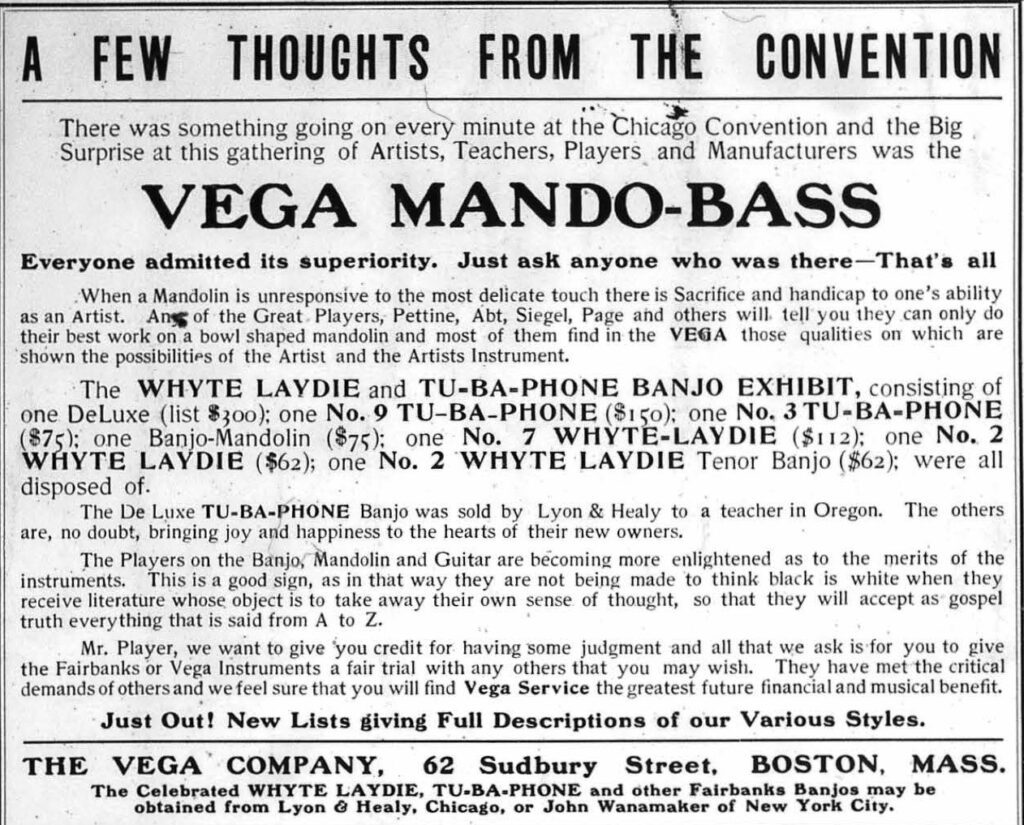
Per the Vega Catalog,
“The Vega Mando-Bass is made on the same general design as the Lute Mandocello. The body is of mahogany with dark finish. Neck is also of mahogany with double bass screw machines for tuning with rolled plate German silver frets. The trimmings comprise an ebony compensating bridge, ebony nut and tailpiece, and reinforced selected strings. The entire instrument is highly French polished. Length over all 63 inches. Depth at bridge 8 inches. Length of scale 37 inches.”
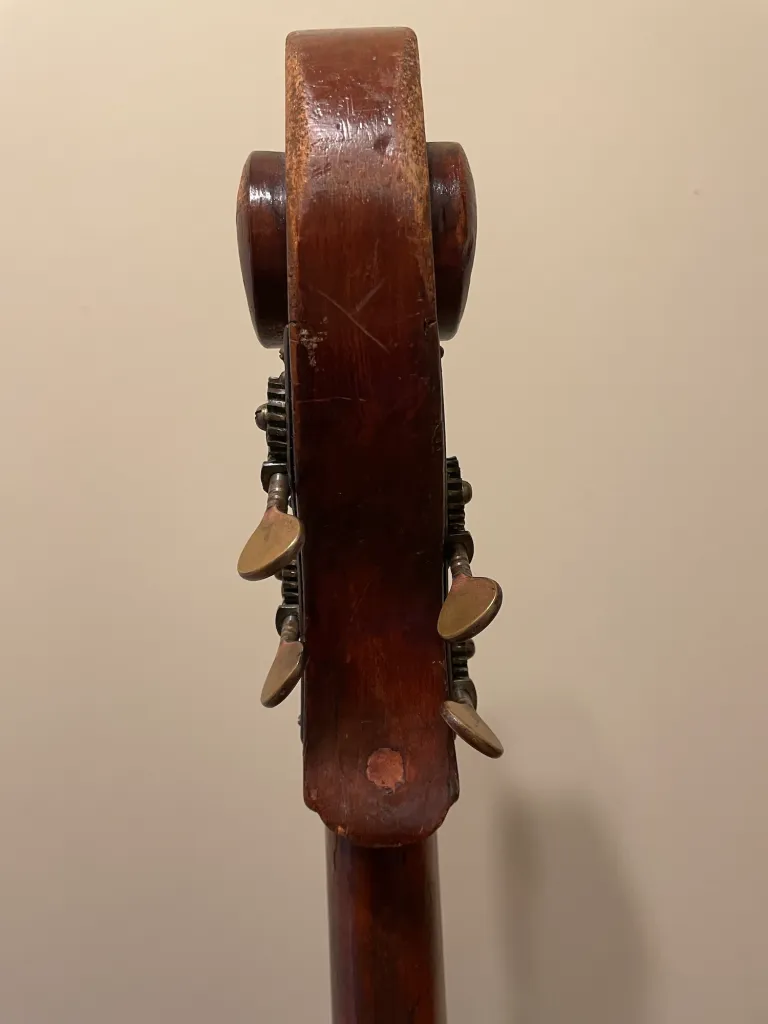
Additional details include star-shaped rosette, ivoroid binding around the top, and a rudimentary scroll headstock.
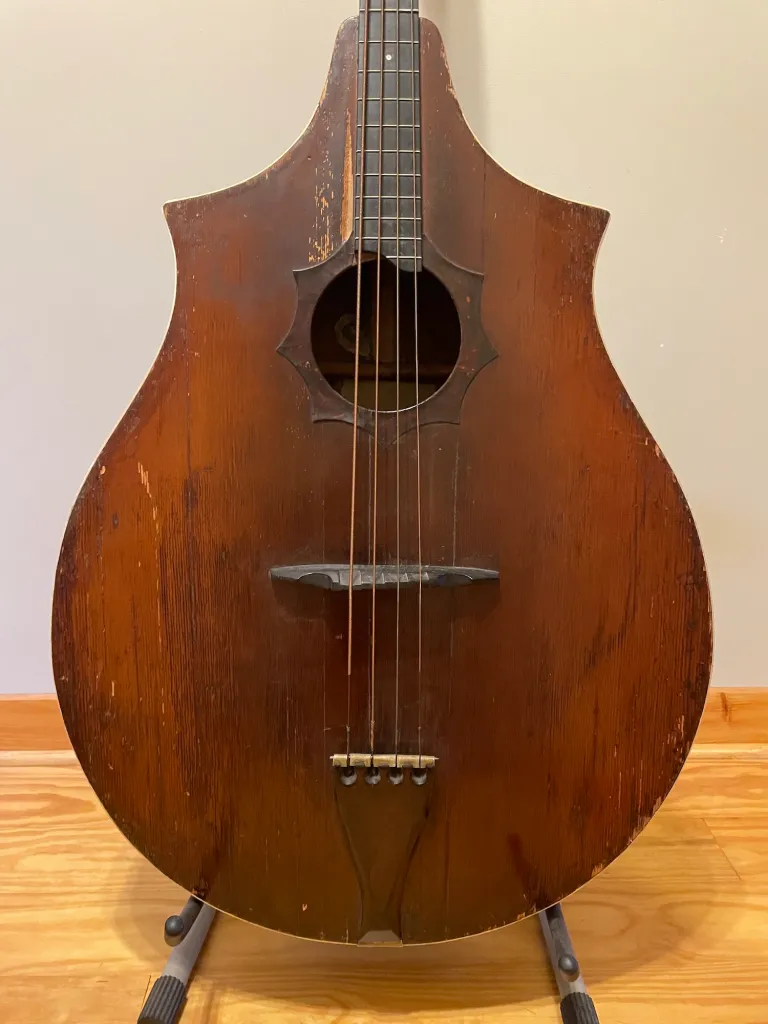
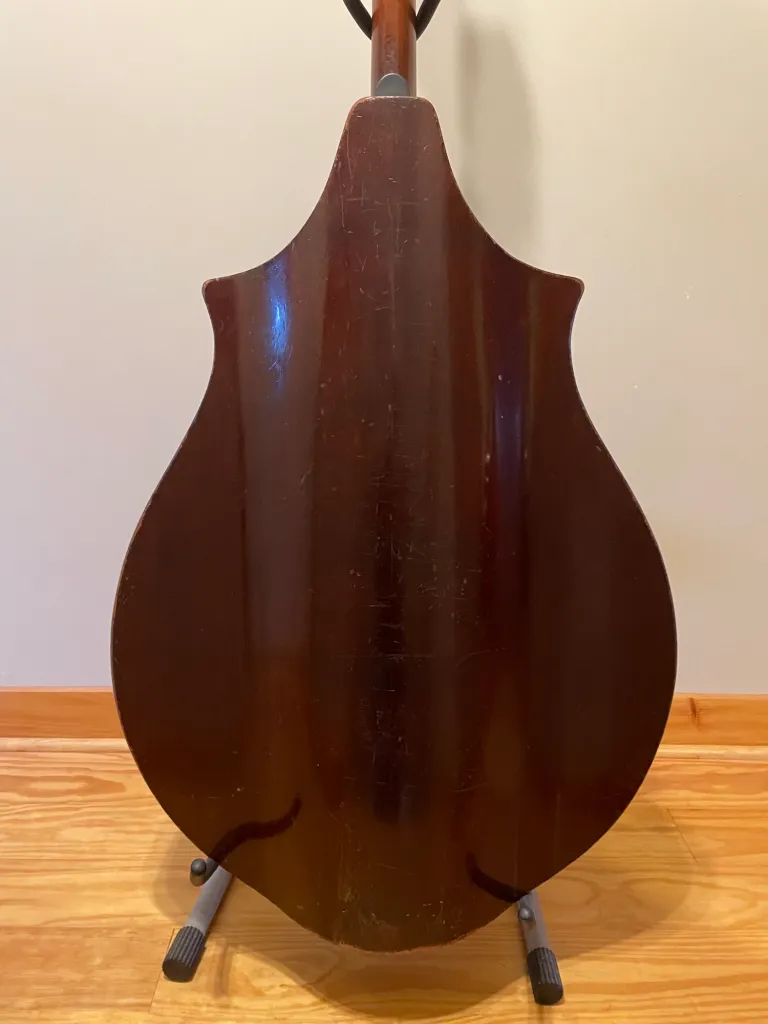
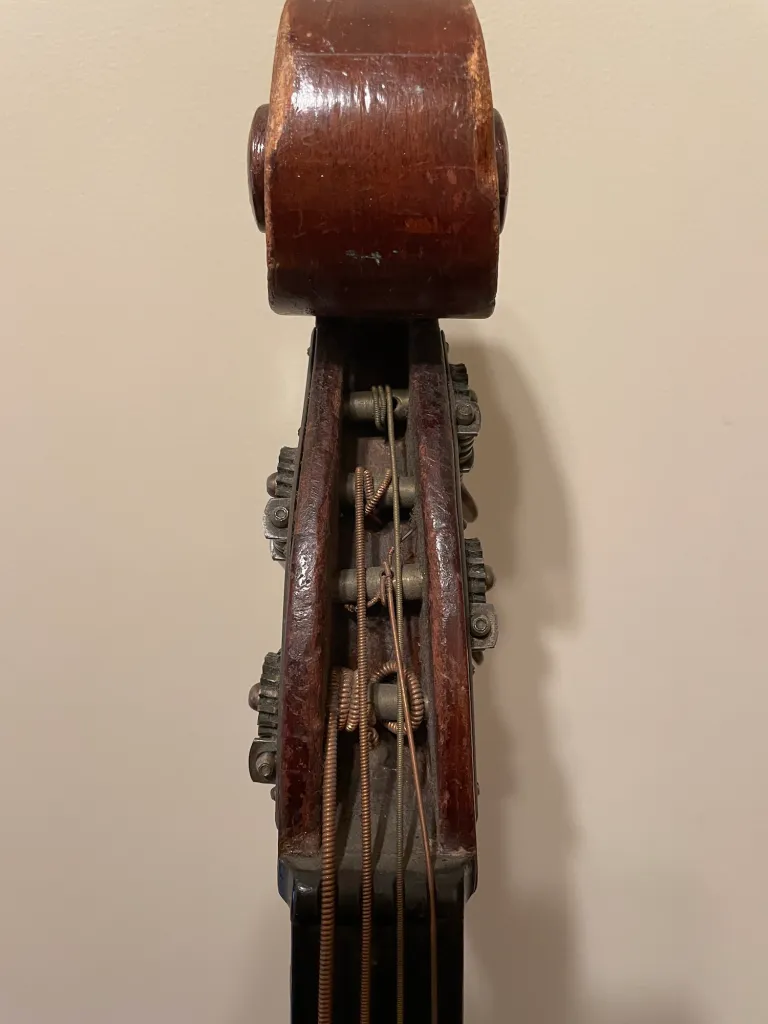
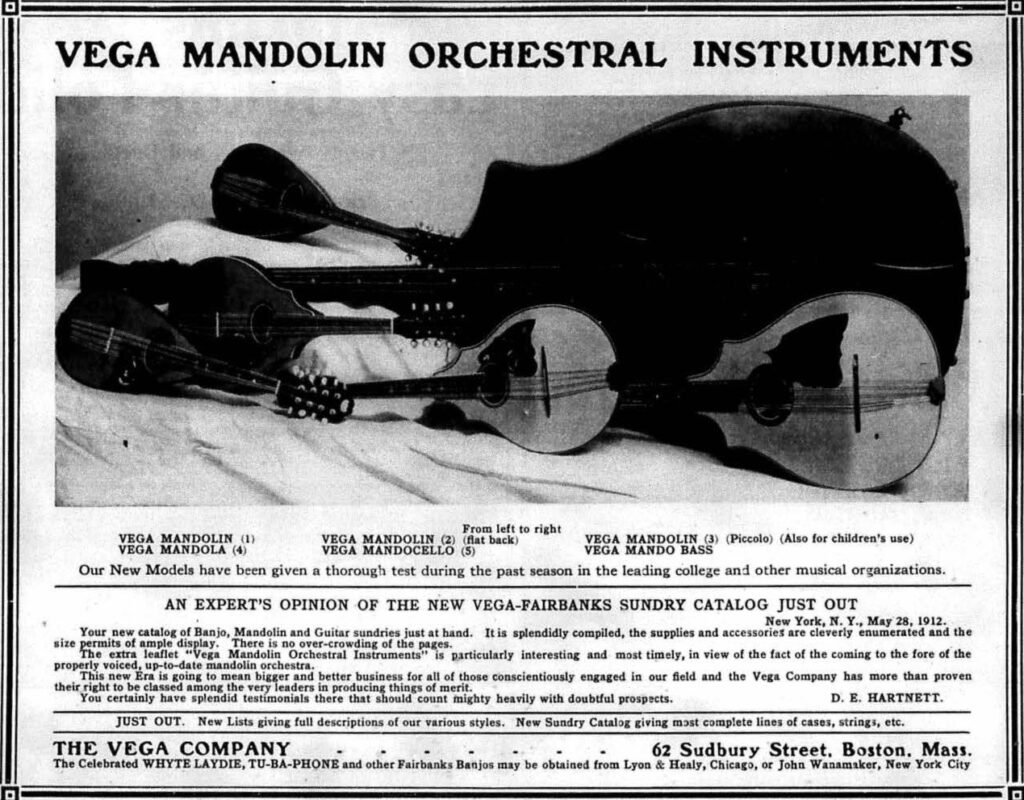
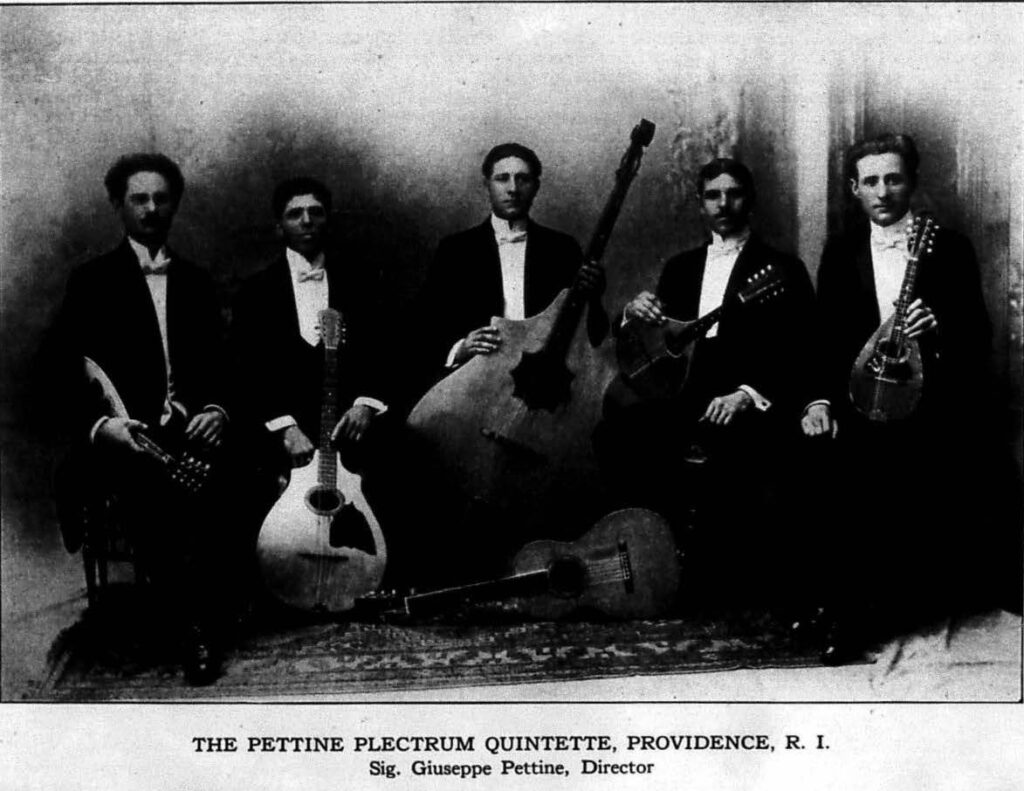
While the advertisement above makes it difficult to discern some of the feature, a Vega Cylinder-Back bass was featured prominently in the Pettine Orchestra and shows a different stain altogether. That bass arguably has a natural stain spruce top. Some years ago, a bass matching those appointments appeared for sale at the Music Emporium in MA. While impossible to know for sure if it is the Pettine bass, it certainly matches up.
In addition to the cylinder-back, Vega also produced a flat-back bass. The most significant differences are that, like Gibson, they increased the scale length from 37 1/4” to 43 1/4” — possibly to adjust for the same tonal issues that Gibson had identified; the top was redesigned to have a slight cant to it and was far less ornamental (no rosette or binding); the body style was similar but the curves from the two points were less dramatic; it was fitted with a pick guard; and the headstock was changed from a violin type scroll to a paddle, typically adorned with the Vega star.
[show flat-back]